Why most AI voice agents lose calls in the first 8 seconds (and how to fix it).
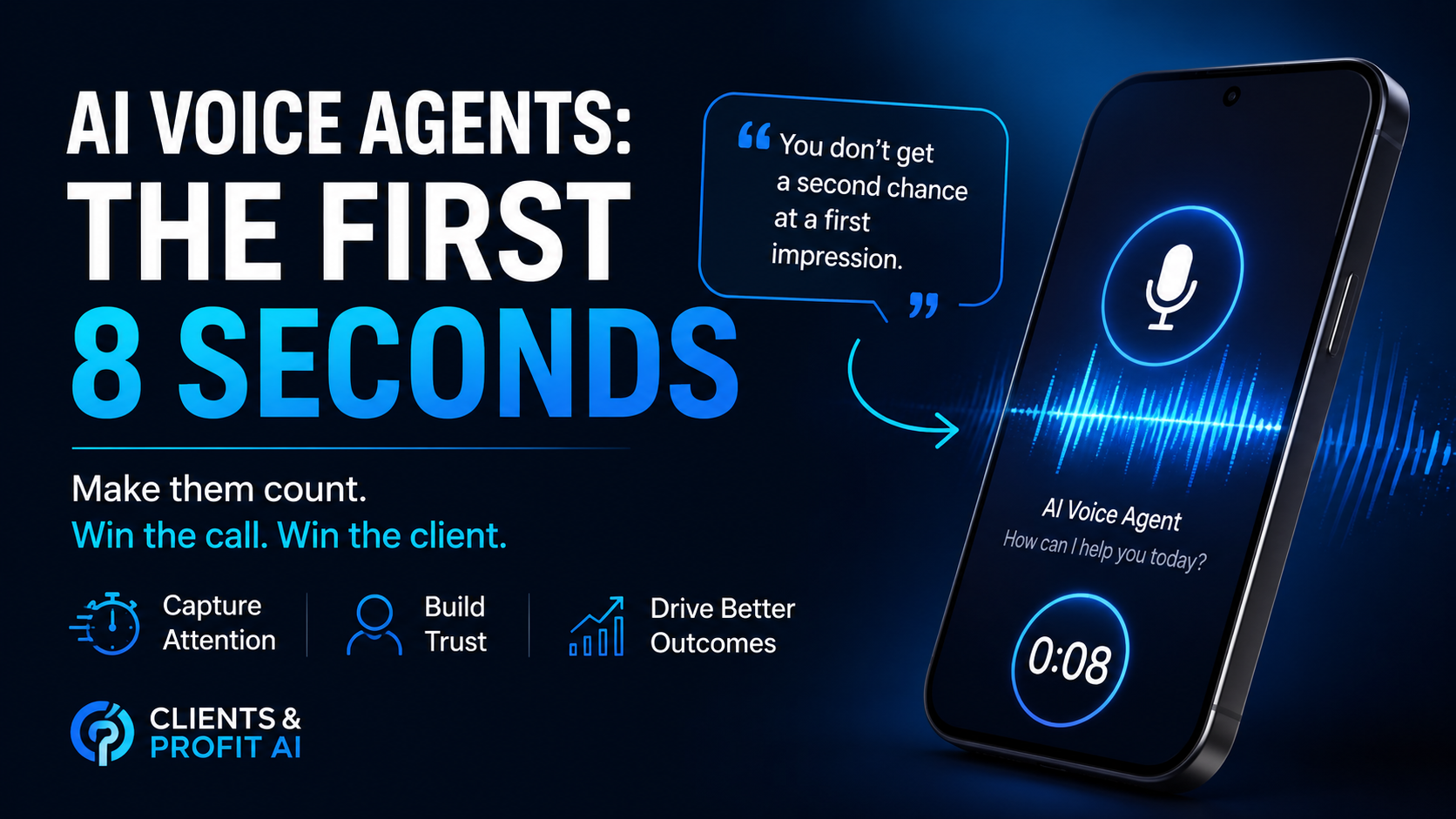
The most expensive mistake in AI voice isn't the script. It's the first eight seconds. By the time most agents get to their pitch, the caller has already decided whether to stay on the line.
Here is the part nobody building AI voice agents wants to hear: your script almost doesn't matter if you lose the open. A caller decides whether they are talking to something worth their time in about eight seconds. Not eight minutes. Eight seconds. Before a single qualifying question. Before the offer. Before any of the clever logic you paid for.
I have listened to thousands of recorded calls, human and AI. The pattern is brutal and consistent. The calls that die, die at the top. And almost every agency obsesses over the middle of the conversation while leaving the most important moment on autopilot.
What actually kills the open
Four things, over and over:
- Latency. A half-second of dead air after the caller speaks and the human brain screams "machine." Real people do not pause like that. Speed is the first trust signal you give.
- A robotic greeting. "Thank you for calling. How may I direct your call today." Nobody talks like that. The second it sounds like a phone tree, people check out.
- Plowing through interruptions. Real callers talk over the greeting. They are impatient. A weak agent keeps reading its line. A strong one shuts up and listens the instant the human speaks.
- Leading with an interrogation. "Can I get your name, your number, and your reason for calling." You have not earned a single answer yet and you are already taking. Give before you take.
The open's job is not to sell. Its job is to buy the next thirty seconds.
The fix: earn the next thirty seconds
Stop thinking about the greeting as a formality and start thinking about it as the first close. Here is the framework I build every agent on.
1. Answer before the ring finishes.
Under one ring. Instant pickup tells the caller, before a word is spoken, that this is a place that has its act together. Slow pickup tells them the opposite.
2. Open like a person, not a portal.
Short, warm, human. Name the business and then sound like an actual employee who is glad they called. Cut every corporate word. If it would feel weird to say it out loud to a friend, it is wrong.
3. Match their energy.
A rushed caller gets a fast, lean response. A chatty caller gets a beat of warmth. An agent that runs the same pace no matter who is on the line feels like a recording, because it is acting like one.
4. Handle the interruption gracefully.
When the caller cuts in, the agent stops cold and listens. This single behavior does more to convince someone they are talking to something intelligent than any line of script. People interrupt. Plan for it.
5. Be useful in the first answer.
Whatever they asked, move it forward immediately. Do not deflect to qualification. Give them one real, helpful thing first. That is what buys you the right to ask anything at all.
Why this is a sales problem, not a tech problem
Any platform can read a script. The reason most AI calls feel like calls with a robot is that they were written by people who build software, not people who have sat across from a hesitant buyer and felt the moment tip. The open is a sales move. It has to be designed by someone who understands that the first eight seconds are where trust is won or lost, then delivered by technology fast enough to pull it off.
That is the whole game. Sound human, move fast, be useful, and you keep them on the line long enough for everything else you built to actually matter.
Watch the AI do this on a live call.
Book a free 30-minute demo. We will show the agent talking to a prospect in your industry, then run your numbers. If it makes sense, we get you launched. If it does not, we tell you.
Book Your Free Demo →