In 2005 I almost got fired for memorizing the company script perfectly. Then I closed my way back by throwing it out. Here is what I learned, and the framework that came out of it.
Early in my career I did exactly what I was told. There was a company script, and I learned it cold. Every word, every transition, every line. I could recite it in my sleep. And I was terrible. I was on the brink of getting fired, sitting in my manager's office being told to turn it around or pack up.
The problem was not that I had the script wrong. The problem was that I had it perfect. I sounded exactly like every other rep reading the exact same words. I was so busy delivering my lines that I was not actually listening to the human in front of me. I was waiting for my turn to talk.
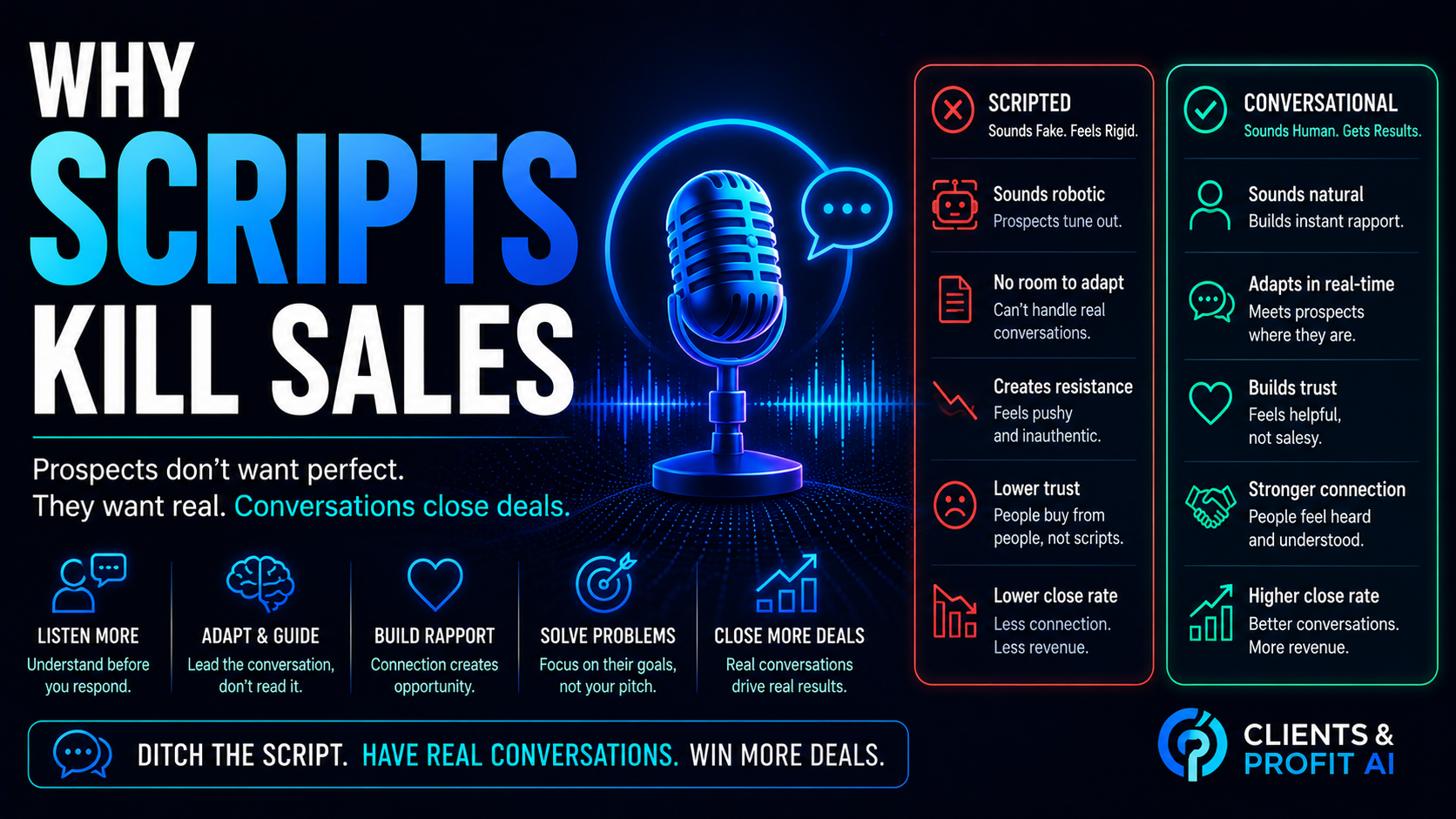
Why scripts kill
A script makes you a reader, not a listener. While the prospect is telling you the single most important thing about their situation, you are scanning ahead to your next line. You miss the opening. You miss the real objection. You miss the moment the conversation tips, because you are performing a monologue at someone instead of having a conversation with them.
Worse, a rigid script cannot bend. Real people interrupt, jump ahead, raise something you were not expecting. A script has no answer for that, so you either ignore them and keep reading, which feels awful, or you fall apart because you are off the page. Either way, you lose.
A script is words to recite. A framework is a path you can walk as a human.
What I did instead
Facing the door, I threw the script out. I stopped trying to say the right words and started paying attention to how real conversations actually closed. I noticed the structure underneath the good ones. There was a path, but the best closers walked it like people, not robots. They listened, they adapted, they stayed human, and they still hit every necessary beat.
That structure became the C.L.O.S.E.D Formula, and later the foundation of everything I teach. It is not a script. It is a framework. A clear path through a sales conversation with room to be a person inside it. The framework keeps you on track so you never lose the thread. Your humanity does the actual closing.
Framework versus script
A script tells you what to say. A framework tells you where you are and where you are going, and lets you get there in your own words, in response to the actual human in front of you. One makes you sound like everyone else. The other makes you sound like the one person who finally listened. Carnegie's line has guided me the whole way: a person convinced against their will is of the same opinion still. Scripts try to convince. Frameworks let people arrive.
"But isn't an AI just a script?"
This is the objection I get the moment I talk about AI voice agents, and it is a fair one. If a script kills a human salesperson, why would I trust an AI reading one? The answer is that a good AI agent is not reading a script. It is running a framework with real branching logic. It listens, it adapts to what the caller actually says, and it walks the path the way a trained closer would, not the way a phone tree does. That is the entire difference between an AI that makes people hang up and one that books the consult. We do not script our agents. We teach them the framework.
The lesson that almost cost me my job is the same one that built everything after it. Stop reciting. Start listening. Give people a path, not a performance.
Watch the AI do this on a live call.
Book a free 30-minute demo. We will show the agent talking to a prospect in your industry, then run your numbers. If it makes sense, we get you launched. If it does not, we tell you.
Book Your Free Demo →