The Objection Decoder: 7 steps to close the deals you keep losing.
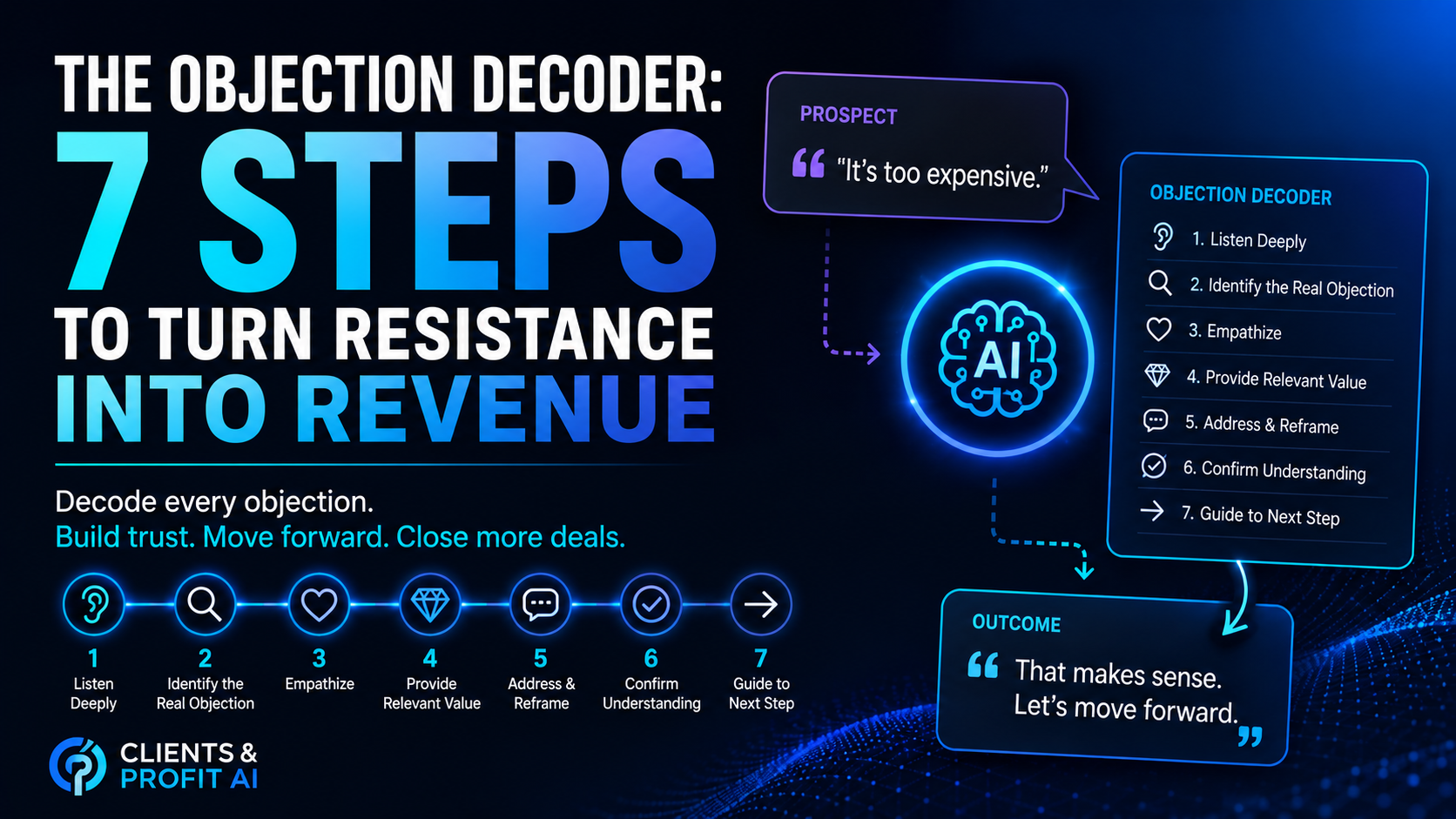
Most business owners handle objections wrong because they were taught to overcome them. You do not overcome an objection. You decode it. Here is the 7-step framework built from 11,000 consults.
Somewhere along the way, sales training decided objections were enemies to be defeated. "Overcome the objection." The language alone tells you everything. It is a fight. And the prospect can feel it. The second they sense you pushing, the wall goes up, and now you are arguing with the person you are trying to help.
After eleven thousand one-on-one sales conversations, I can tell you the close has almost nothing to do with overcoming anything. An objection is not a no. It is a piece of missing information or a hesitation the prospect has not said out loud yet. Your job is to decode it.
A person convinced against their will is of the same opinion still.
Dale Carnegie said it, and it is the foundation of everything I teach. You cannot bulldoze someone into a yes that lasts. You decode what is really going on, hand them the missing piece, and let them talk themselves into it.
The 7 steps
1. Acknowledge before you respond.
The instant you hear the objection, lower the temperature. "Totally fair." "I hear you." You are not agreeing. You are signaling that pushing is not coming, which is the only thing that gets the wall back down.
2. Find the objection under the objection.
Almost every "it costs too much" is something else wearing a price costume. It is doubt that it will work. It is fear of another thing that failed. It is not being sure they are the one who decides. Price is the easiest thing to say and rarely the real thing.
3. Isolate it.
"If we set that aside for a second, is there anything else holding you back, or is that the one thing?" Now you know if you are solving the real issue or chasing a decoy.
4. Reflect it back.
Say their concern back to them in your own words until they say "exactly." People do not move until they feel understood. This is the step everyone skips and it is the one that matters most.
5. Reframe with the missing piece.
Now, and only now, you give them the information or the angle they did not have. Not a rebuttal. A reframe. You are not winning a point. You are completing their picture.
6. Confirm it landed.
"Does that put it to rest for you?" If yes, you move. If no, you missed the real objection and you loop back to step two. Do not close on top of a doubt you only think you handled.
7. Ask for the decision.
Once the doubt is genuinely gone, ask. Clearly and without flinching. The close is not a trick at the end. It is the natural next step once there is nothing real left in the way.
Why this runs on every AI call we build
This framework is exactly what we train into the AI voice agents at Clients & Profit AI. Not a list of canned rebuttals, which is what makes most AI sound like a robot fighting you. A decode path, with the branching logic to find the real objection and the patience to make a prospect feel heard before it ever reframes. It is the difference between an agent that argues and one that closes.
Watch the AI do this on a live call.
Book a free 30-minute demo. We will show the agent talking to a prospect in your industry, then run your numbers. If it makes sense, we get you launched. If it does not, we tell you.
Book Your Free Demo →